WordPress vs Custom Website: Which Is Better for Your Business in 2026?
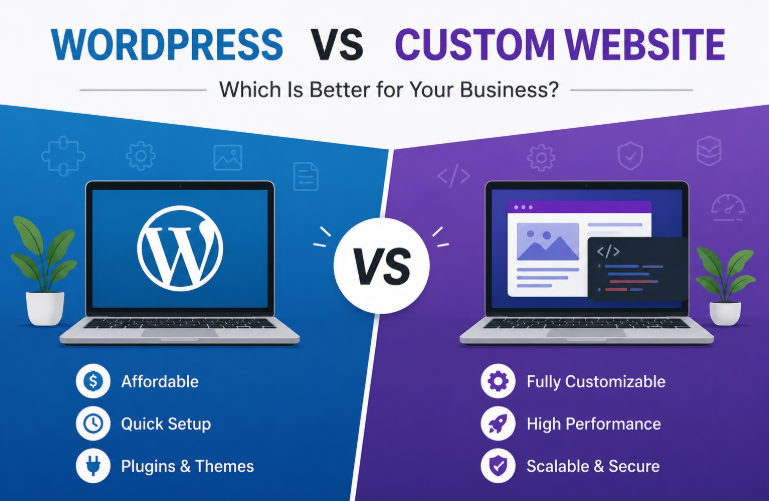
WordPress vs Custom Website: Which Is Better for Your Business in 2026?
Building a website is no longer optional for most businesses, freelancers, bloggers, and entrepreneurs. Whether you are launching an online store, starting a blog, promoting a service, or building a digital platform, one important question usually comes up:
Should you use WordPress, or should you build a custom website from scratch?
Both options have advantages and disadvantages. WordPress is popular because it is flexible, relatively affordable, and easy to manage. A custom website, on the other hand, offers complete control over design, functionality, performance, and future development.
So, which one is better?
The honest answer is: it depends on your goals, budget, technical requirements, and long-term plans.
In this guide, we will compare WordPress and custom websites in detail. By the end, you should have a clear idea of which option is the right choice for your project.
What Is a WordPress Website?
WordPress is one of the world's most popular content management systems (CMS). It allows users to create and manage websites without building every feature from the ground up.
With WordPress, you can use:
-
Themes for website design
-
Plugins for additional functionality
-
Page builders for visual editing
-
SEO plugins
-
E-commerce plugins
-
Security tools
-
Caching and performance plugins
A WordPress website can be used for almost anything, including:
-
Blogs
-
Business websites
-
News websites
-
Affiliate websites
-
Online stores
-
Membership platforms
-
Portfolio websites
-
Educational websites
-
Real estate websites
-
Online magazines
The biggest advantage of WordPress is that you do not need to develop every feature manually. Thousands of themes and plugins are available to speed up development.
However, WordPress also has limitations. Since many websites rely on third-party themes and plugins, performance, security, and customization can sometimes become complicated.
What Is a Custom Website?
A custom website is built specifically for a particular business, organization, or project.
Instead of relying primarily on pre-built themes and plugins, developers create the website's design, database structure, features, and functionality according to the project's requirements.
A custom website may be built using technologies such as:
-
PHP
-
Laravel
-
CodeIgniter
-
JavaScript
-
React
-
Vue
-
Node.js
-
MySQL
-
PostgreSQL
-
HTML and CSS
For example, a custom website could be created for:
-
A unique SaaS platform
-
A large marketplace
-
A complex booking system
-
A custom accounting application
-
A specialized business management system
-
A social networking platform
-
A large-scale e-commerce system
The main advantage of a custom website is complete control. You are not limited to the functionality of an existing theme or plugin.
WordPress vs Custom Website: Quick Comparison
| Feature | WordPress | Custom Website |
|---|---|---|
| Initial Cost | Usually lower | Usually higher |
| Development Time | Faster | Longer |
| Customization | High | Almost unlimited |
| Ease of Use | Excellent | Depends on development |
| SEO | Very good | Can be excellent |
| Performance | Depends on setup | Highly controllable |
| Security | Requires updates and maintenance | Custom security management |
| Scalability | Good with proper setup | Excellent |
| Maintenance | Often easier | Usually requires developers |
| Best For | Blogs, small businesses, content websites | Complex platforms and unique systems |
Both options can be excellent. The important thing is choosing the right solution for your specific needs.
1. Cost: Which Option Is More Affordable?
For many website owners, cost is one of the biggest deciding factors.
WordPress Cost
A basic WordPress website may require expenses such as:
-
Domain name
-
Web hosting
-
Premium theme
-
Premium plugins
-
Website development
-
Security tools
-
Maintenance
The initial cost is often lower because many features are already available through themes and plugins.
For example, a small business may be able to launch a professional WordPress website without paying for months of custom development.
However, WordPress costs can increase over time.
You may need to pay for:
-
Premium plugins
-
Theme renewals
-
Security services
-
Performance optimization
-
Developer support
-
Additional functionality
A website that initially appears inexpensive can become more expensive if it requires many premium tools.
Custom Website Cost
Custom websites generally cost more at the beginning because developers must create the system specifically for you.
The cost depends on:
-
Website complexity
-
Number of features
-
Design requirements
-
User accounts
-
Payment systems
-
APIs
-
Admin dashboards
-
Database structure
-
Security requirements
A simple custom website may be affordable, but a complex platform can require a significant development budget.
Winner: WordPress for Most Small Projects
If your goal is to launch a blog, portfolio, business website, or basic online store, WordPress is usually more cost-effective.
For a complex platform with unique requirements, a custom website may provide better long-term value.
2. Development Speed
How quickly do you need your website?
This question can significantly influence your decision.
A WordPress website can often be launched quickly because many components already exist. A developer can install WordPress, configure a theme, add plugins, customize the design, and publish the website.
This is especially useful for:
-
Startups
-
Bloggers
-
Small businesses
-
Affiliate marketers
-
Freelancers
A custom website usually takes longer to build because developers must create the system from scratch.
The development process may include:
-
Planning
-
UI/UX design
-
Database planning
-
Frontend development
-
Backend development
-
API integration
-
Testing
-
Security testing
-
Deployment
Winner: WordPress
If speed is important, WordPress usually has a significant advantage.
However, speed should not be the only factor. A custom solution may take longer initially but could provide better functionality for a complex project.
3. Customization and Flexibility
This is one of the biggest differences between WordPress and custom websites.
WordPress offers a huge amount of flexibility. You can customize themes, install plugins, modify code, and create custom functionality.
However, WordPress still operates within the structure of its ecosystem.
Sometimes you may want a feature that does not work well with existing plugins. You may need to customize multiple systems or create a custom plugin.
A custom website gives developers complete control.
You can decide:
-
How the database works
-
How users interact with the platform
-
How the dashboard operates
-
How payments are processed
-
How content is stored
-
How APIs communicate
-
How permissions are managed
For example, if you want to build a unique freelance marketplace with a custom bidding system, wallet system, commission system, and advanced user verification, a custom application may be more suitable.
Winner: Custom Website
For highly specialized functionality, custom development is the clear winner.
4. SEO: Which Is Better for Google Rankings?
Many people ask whether WordPress is better for SEO than a custom website.
The truth is that neither platform automatically guarantees higher Google rankings.
SEO depends on many factors, including:
-
Content quality
-
Search intent
-
Website structure
-
Page speed
-
Mobile usability
-
Technical SEO
-
Internal linking
-
Backlinks
-
User experience
WordPress makes SEO easier for many beginners because you can use SEO plugins and tools to manage important settings.
You can easily control:
-
Meta titles
-
Meta descriptions
-
XML sitemaps
-
Canonical URLs
-
Schema markup
-
Robots.txt
-
Open Graph data
A custom website can also be highly SEO-friendly. In fact, a well-built custom website can offer excellent technical performance.
However, SEO features must usually be developed manually.
Winner: Tie
WordPress is often easier for SEO beginners.
A properly developed custom website can perform just as well—or even better—technically.
The platform itself is not the primary ranking factor.
5. Website Performance and Speed
Website speed is important for both users and search engines.
A slow website can result in:
-
Higher bounce rates
-
Lower conversions
-
Poor user experience
-
Reduced engagement
WordPress performance depends heavily on how the website is built.
Common causes of slow WordPress websites include:
-
Too many plugins
-
Poor-quality hosting
-
Heavy themes
-
Unoptimized images
-
Poorly coded plugins
-
Excessive scripts
-
Lack of caching
However, a well-optimized WordPress website can be very fast.
A custom website may have an advantage because developers can build only the features that are necessary.
Instead of loading dozens of plugins, the website can be designed with a focused codebase.
This can potentially improve:
-
Page loading speed
-
Server response time
-
Database efficiency
-
Overall performance
Winner: Custom Website, If Properly Developed
A custom website generally offers more control over performance.
However, a badly developed custom website can still be slower than a properly optimized WordPress website.
The quality of development matters more than the platform name.
6. Security
Website security is another major consideration.
WordPress is a popular target for hackers partly because it powers a huge number of websites worldwide.
Common WordPress security problems can result from:
-
Outdated plugins
-
Vulnerable themes
-
Weak passwords
-
Poor hosting
-
Outdated WordPress versions
-
Untrusted plugins
The good news is that WordPress can be very secure when properly maintained.
Important security practices include:
-
Keeping WordPress updated
-
Using trusted plugins
-
Installing security monitoring
-
Using strong passwords
-
Enabling two-factor authentication
-
Maintaining regular backups
-
Using secure hosting
Custom websites also require security maintenance.
A custom system may have unique vulnerabilities if the code is poorly written.
Security problems may involve:
-
SQL injection
-
Cross-site scripting
-
Broken authentication
-
Poor access control
-
Insecure APIs
-
Weak server configuration
Winner: Depends on Development Quality
A secure WordPress website can be safer than a poorly coded custom website.
Likewise, a professionally developed custom system can provide excellent security.
The most important factors are:
-
Code quality
-
Regular updates
-
Security testing
-
Server configuration
-
Maintenance
7. Ease of Content Management
If you plan to publish content regularly, WordPress is extremely convenient.
The WordPress dashboard allows users to:
-
Create blog posts
-
Upload images
-
Manage categories
-
Add tags
-
Edit pages
-
Manage comments
-
Add users
-
Schedule content
This is one reason WordPress is so popular among bloggers and content creators.
A custom website can also include a content management system, but that system must be developed.
You may need to build:
-
Admin dashboards
-
Post editors
-
Media managers
-
Category systems
-
User roles
-
Publishing tools
This can be perfectly effective, but it requires additional development.
Winner: WordPress
For content-focused websites, WordPress is usually the more convenient choice.
8. Scalability
Scalability refers to how well a website can grow as traffic, users, and data increase.
Many people assume that WordPress cannot handle large websites. This is not entirely true.
With:
-
Good hosting
-
Proper caching
-
Database optimization
-
Content delivery networks
-
Efficient themes
-
Carefully selected plugins
WordPress can support very large websites.
However, custom websites often provide more control when building highly specialized systems.
A custom platform can be designed specifically for:
-
Millions of users
-
Large databases
-
Complex user relationships
-
Advanced automation
-
High-volume transactions
Winner: Custom Website for Complex Platforms
For a simple blog or business website, WordPress can scale very well.
For large applications with unique technical requirements, custom development usually provides more flexibility.
9. Maintenance and Updates
WordPress websites require regular maintenance.
This may include:
-
Updating WordPress
-
Updating themes
-
Updating plugins
-
Checking compatibility
-
Monitoring security
-
Creating backups
Sometimes an update can create compatibility issues.
Custom websites also require maintenance, but the process is different.
You may need developers to:
-
Fix bugs
-
Update server software
-
Improve features
-
Upgrade frameworks
-
Monitor security
-
Maintain APIs
Winner: WordPress for Non-Technical Users
WordPress is usually easier for business owners who want to manage basic website operations themselves.
Custom websites often require ongoing technical support.
10. Design and Branding
WordPress offers thousands of themes. This makes it easy to launch a professional-looking website quickly.
However, popular themes are often used by many other websites.
If you want a completely unique design, you may need:
-
A custom WordPress theme
-
Professional design work
-
Custom frontend development
A custom website allows you to design every part of the user experience from the beginning.
You can create:
-
Unique layouts
-
Custom dashboards
-
Special animations
-
Custom user journeys
-
Brand-specific interfaces
Winner: Custom Website
Both options can look professional, but custom development offers greater creative freedom.
11. E-Commerce Websites
WordPress can be a great option for many online stores.
You can add:
-
Product pages
-
Shopping carts
-
Payment gateways
-
Customer accounts
-
Coupons
-
Inventory management
For small and medium-sized online stores, WordPress can be an excellent choice.
However, if you need a highly specialized e-commerce platform with complex business rules, a custom system may be more appropriate.
For example, a custom solution may be better for:
-
Large marketplaces
-
Multi-vendor platforms
-
Complex product configurations
-
Custom pricing systems
-
Advanced logistics systems
Winner: Depends on the Store
Small and medium-sized stores: WordPress may be ideal.
Large and complex e-commerce systems: Custom development may be more suitable.
12. Plugin Dependency vs Custom Code
One of the biggest advantages of WordPress is its plugin ecosystem.
You can add features without building everything yourself.
However, relying too heavily on plugins can create problems.
For example:
-
Plugin conflicts
-
Security vulnerabilities
-
Performance problems
-
Compatibility issues
-
Subscription costs
A custom website generally has fewer third-party dependencies.
This can provide more control over the codebase.
However, custom development also means you are responsible for building and maintaining everything.
Winner: Depends on the Project
Plugins save time and money.
Custom code provides control and independence.
When Should You Choose WordPress?
WordPress is an excellent choice if you want to:
-
Start a blog
-
Build a business website
-
Launch an affiliate website
-
Create a portfolio
-
Publish content regularly
-
Start a small online store
-
Build a news website
-
Launch a magazine website
-
Test a business idea quickly
WordPress is especially useful when:
-
Your budget is limited
-
You need a website quickly
-
You want to manage content yourself
-
You do not require highly unusual functionality
For many small businesses and online entrepreneurs, WordPress provides the best balance between cost, speed, and flexibility.
When Should You Choose a Custom Website?
A custom website may be a better choice if you need:
-
Unique business logic
-
A specialized web application
-
Complex user roles
-
Advanced automation
-
Large-scale scalability
-
A unique marketplace
-
Custom payment systems
-
Complex dashboards
-
Specialized database structures
You should seriously consider custom development when existing WordPress plugins cannot properly meet your requirements.
Trying to force a complicated business system into WordPress can sometimes create unnecessary problems.
Can You Combine WordPress and Custom Development?
Yes.
Many successful websites use a combination of both approaches.
For example, you might use WordPress for:
-
Blog content
-
Marketing pages
-
SEO
-
News articles
And use a custom application for:
-
User dashboards
-
SaaS features
-
Customer management
-
Advanced tools
This hybrid approach can provide the best of both worlds.
For example:
example.com could run on WordPress for marketing content, while app.example.com could run on a custom Laravel, Node.js, or other application.
This approach is especially useful for growing businesses.
Common Mistakes to Avoid
Choosing Custom Development Just Because It Sounds More Professional
Custom does not automatically mean better.
If you only need a simple blog, building everything from scratch may waste time and money.
Installing Too Many WordPress Plugins
Plugins are useful, but installing unnecessary plugins can slow down your website and create security risks.
Only install tools that you actually need.
Choosing the Cheapest Developer
A cheap website can become expensive if it is poorly built.
Always consider:
-
Code quality
-
Experience
-
Support
-
Security
-
Long-term maintenance
Ignoring Website Performance
A beautiful website is not useful if visitors leave because it takes too long to load.
Performance should be considered from the beginning.
Forgetting About Future Growth
Think about where your website may be in three or five years.
A solution that works today may not be suitable for your future plans.
My Final Verdict: WordPress or Custom Website?
There is no universal winner.
WordPress is better for many blogs, small businesses, content websites, affiliate websites, and standard online stores.
It is affordable, fast to launch, easy to manage, and highly flexible.
A custom website is better for complex applications, unique business systems, specialized marketplaces, and projects that require complete control.
The best choice depends on your goals.
If you are starting a new website with a limited budget, WordPress is often the smartest starting point.
If your business requires functionality that cannot be achieved efficiently with existing tools, custom development may be the better investment.
The most important question is not:
“Which technology is more popular?”
The better question is:
“Which solution fits my business requirements today and supports my goals tomorrow?”
Choose the technology based on your actual needs—not simply because someone says one platform is always better.
For many businesses, the ideal strategy is to start with WordPress, validate the business idea, grow the audience, and later invest in custom development when the need becomes clear.
For others, starting with a custom website from day one may save time and prevent future limitations.
In the end, both WordPress and custom websites can produce fast, secure, SEO-friendly, and successful online businesses when they are properly planned, developed, and maintained.

developeradmin
GearInspector contributor. Passionate about helping you make smarter buys.