AI vs Traditional Software: Which Is Better for Modern Businesses in 2026?
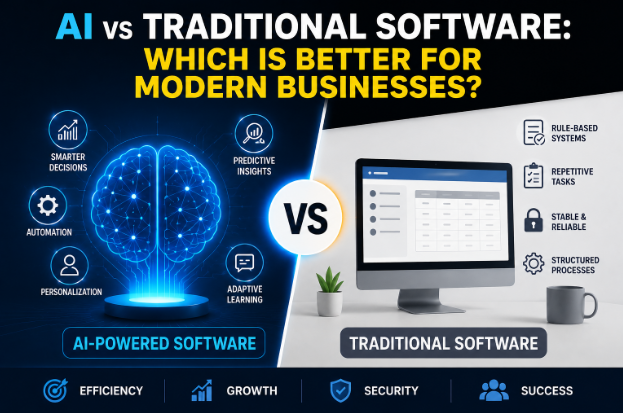
AI vs Traditional Software: Which Is Better for Modern Businesses?
Technology has always been the driving force behind business innovation. From simple accounting software to cloud-based enterprise solutions, businesses have relied on software to improve productivity, streamline operations, and reduce costs. However, the rapid rise of Artificial Intelligence (AI) has introduced a new generation of intelligent software capable of learning, adapting, and making decisions with minimal human intervention.
Today, organizations of every size are asking the same question: Should they continue using traditional software, or is it time to adopt AI-powered solutions?
The answer isn't as straightforward as choosing one over the other. While traditional software remains essential for many business operations, AI offers capabilities that conventional systems simply cannot match. It can analyze massive amounts of data, automate complex tasks, predict future trends, and even generate content, making it one of the most transformative technologies of 2026.
In this comprehensive guide, we'll compare AI and traditional software, explore their strengths and limitations, and help you determine which option is best for your business.
What Is Traditional Software?
Traditional software refers to applications that follow predefined rules and instructions written by developers.
These programs perform specific tasks exactly as they are programmed to do. They cannot learn from experience or improve themselves unless a developer updates the software.
Examples of traditional software include:
- Accounting software
- Payroll systems
- Inventory management systems
- Spreadsheet applications
- Word processors
- Customer databases
- Point-of-sale (POS) systems
- Basic CRM platforms
For example, if accounting software is programmed to calculate taxes using specific formulas, it will always follow those exact formulas until someone changes the code.
Traditional software is reliable, predictable, and works exceptionally well for structured tasks with clearly defined rules.
What Is Artificial Intelligence (AI)?
Artificial Intelligence refers to computer systems that can perform tasks that typically require human intelligence.
Unlike traditional software, AI systems can:
- Learn from data
- Identify patterns
- Understand natural language
- Recognize images
- Make predictions
- Generate content
- Improve performance over time
- Assist with decision-making
Instead of relying solely on fixed programming, AI continuously analyzes information and adapts its responses based on new data.
For example:
A traditional customer support system may display a list of frequently asked questions.
An AI-powered assistant, however, can understand a customer's question, interpret the context, provide a personalized answer, and continue the conversation naturally.
This ability to learn and adapt is what makes AI fundamentally different from traditional software.
The Evolution of Business Software
Business software has evolved significantly over the past few decades.
First Generation: Manual Processes
Businesses once relied on paper records, calculators, and handwritten documents to manage operations.
Tasks such as payroll, inventory tracking, and customer records required significant manual effort.
Second Generation: Traditional Software
The introduction of desktop software revolutionized business management.
Companies could automate repetitive calculations, organize customer information, and generate reports more efficiently.
Although these systems improved productivity, they still depended entirely on predefined programming.
Third Generation: Cloud Computing
Cloud-based software made business tools more accessible.
Organizations gained real-time collaboration, remote access, automatic updates, and scalable infrastructure.
Cloud platforms continue to power many modern businesses today.
Fourth Generation: AI-Powered Software
Today's AI-powered platforms go beyond automation.
They can:
- Predict customer behavior
- Recommend business strategies
- Generate marketing content
- Analyze financial trends
- Detect fraud
- Improve customer service
- Optimize supply chains
Rather than simply following instructions, AI helps businesses make smarter decisions.
Key Differences Between AI and Traditional Software
Although both technologies improve business efficiency, they operate very differently.
| Feature | Traditional Software | AI-Powered Software |
|---|---|---|
| Decision Making | Rule-based | Learns from data |
| Adaptability | Limited | Continuously improves |
| Automation | Fixed workflows | Intelligent automation |
| Learning Ability | None | Yes |
| Data Analysis | Basic | Advanced predictive analytics |
| Customer Interaction | Predefined responses | Personalized conversations |
| Flexibility | Low | High |
| Problem Solving | Pre-programmed | Dynamic reasoning |
Understanding these differences helps businesses choose the right solution for their specific needs.
Why Businesses Are Moving Toward AI
Across industries, organizations are increasingly adopting AI-powered solutions.
Several factors are driving this transition.
Higher Productivity
AI automates repetitive and time-consuming tasks.
Instead of manually sorting emails, analyzing spreadsheets, or responding to customer inquiries, AI can complete these tasks in seconds.
Employees spend less time on routine work and more time on strategic activities.
Better Decision-Making
Modern businesses generate enormous amounts of data.
Traditional software can store and organize information, but AI can interpret it.
AI analyzes:
- Customer behavior
- Market trends
- Sales performance
- Financial data
- Website traffic
- Inventory patterns
These insights help business leaders make faster and more informed decisions.
Improved Customer Experience
Customers now expect personalized interactions.
AI enables businesses to deliver:
- Personalized recommendations
- Instant customer support
- Predictive product suggestions
- Customized marketing campaigns
- Faster response times
Traditional software often lacks the intelligence needed to create these individualized experiences.
Smarter Automation
Automation has existed for decades.
However, traditional automation only works within predefined rules.
For example:
Traditional software can automatically send an invoice after payment.
AI can:
- Detect unusual purchasing behavior
- Predict late payments
- Recommend follow-up actions
- Personalize communication
- Identify high-value customers
This level of intelligent automation creates significantly greater business value.
Where Traditional Software Still Excels
Despite AI's rapid growth, traditional software remains highly valuable.
Many business tasks don't require advanced intelligence.
Traditional software performs exceptionally well when processes are:
- Stable
- Repetitive
- Highly structured
- Rule-based
- Compliance-driven
Examples include:
Accounting Calculations
Financial formulas rarely change.
Traditional accounting software performs these calculations accurately and consistently.
Payroll Processing
Payroll systems follow legal regulations and predefined formulas.
Traditional software remains highly reliable for these tasks.
Inventory Records
Recording inventory quantities doesn't necessarily require AI.
Simple inventory management software often provides all the functionality many businesses need.
Document Storage
Traditional document management systems effectively organize files without requiring machine learning.
Where AI Outperforms Traditional Software
AI demonstrates its greatest strengths when dealing with complex, dynamic, or unpredictable situations.
Some examples include:
Customer Support
AI-powered chatbots can understand customer questions, provide personalized answers, and learn from previous interactions.
Traditional FAQ systems cannot adapt in the same way.
Marketing
AI analyzes customer behavior and creates highly targeted marketing campaigns.
Traditional software typically requires manual segmentation and campaign management.
Sales Forecasting
AI predicts future sales using historical trends, customer behavior, seasonal demand, and market conditions.
Traditional reporting tools generally focus on past performance rather than future predictions.
Fraud Detection
Financial institutions increasingly rely on AI to detect suspicious transactions in real time.
Unlike rule-based systems, AI continuously learns new fraud patterns and adapts to emerging threats.
Content Creation
Generative AI can produce:
- Blog articles
- Email campaigns
- Product descriptions
- Social media posts
- Advertising copy
- Business reports
Traditional software offers formatting tools but cannot generate original content.

developeradmin
GearInspector contributor. Passionate about helping you make smarter buys.