Generative AI Explained: How It Works and Why It Matters in 2026
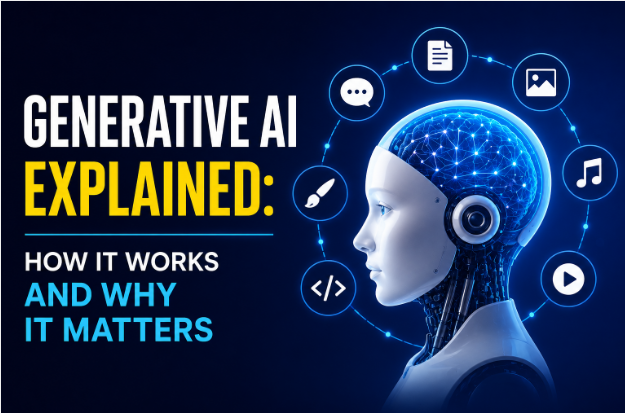
Generative AI Explained: How It Works and Why It Matters in 2026
Artificial Intelligence has become one of the most revolutionary technologies of the modern era. From recommending movies on streaming platforms to helping doctors diagnose diseases, AI is changing nearly every aspect of our lives. But among all the recent advancements in artificial intelligence, one innovation has attracted more attention than any other: Generative AI.
Unlike traditional AI systems that analyze information or make predictions, Generative AI can actually create new content. It can write articles, generate images, compose music, design logos, write computer code, produce videos, and even hold conversations that feel remarkably human.
In just a few years, Generative AI has evolved from a fascinating research project into a practical tool used by businesses, students, marketers, developers, designers, and creators around the world. Whether you're using an AI chatbot to brainstorm ideas or an AI image generator to create artwork, you're experiencing the power of Generative AI firsthand.
But how does this technology actually work? Why has it become so important? And what does its rapid growth mean for our future?
In this guide, we'll explore everything you need to know about Generative AI, from the technology behind it to its real-world applications, benefits, challenges, and future impact.
What Is Generative AI?
Generative AI is a type of artificial intelligence designed to create new content rather than simply analyze existing data.
Traditional AI is mainly used for tasks such as:
- Detecting spam emails
- Recommending products
- Identifying faces in photos
- Predicting customer behavior
- Classifying images
Generative AI goes much further.
Instead of simply recognizing patterns, it learns those patterns and uses them to generate completely new outputs that resemble human-created content.
Depending on the model, Generative AI can create:
- Articles
- Emails
- Computer code
- Images
- Videos
- Music
- Voice recordings
- Marketing copy
- Product descriptions
- Business reports
- Presentations
- 3D designs
The quality of these outputs has improved dramatically, making Generative AI useful for both personal and professional tasks.
How Does Generative AI Work?
Although Generative AI may seem almost magical, its operation is based on advanced machine learning techniques and massive amounts of training data.
At a high level, the process works like this:
Step 1: Learning From Massive Datasets
Before an AI model can generate content, it must first learn from enormous collections of information.
These datasets may include:
- Books
- Articles
- Websites
- Research papers
- Images
- Videos
- Audio recordings
- Computer code
- Public documents
During training, the AI identifies relationships, structures, grammar, visual patterns, and contextual information.
Rather than memorizing everything, it learns statistical patterns that allow it to predict what should come next.
Step 2: Pattern Recognition
After processing billions—or even trillions—of pieces of information, the AI begins recognizing patterns.
For example, it learns:
- Sentence structures
- Writing styles
- Programming syntax
- Artistic techniques
- Musical composition
- Logical reasoning
- Language relationships
This enables the model to generate original content that follows similar patterns.
Step 3: Content Generation
When a user enters a prompt, the AI doesn't search the internet for an answer.
Instead, it predicts the most appropriate sequence of words, pixels, sounds, or code based on everything it learned during training.
For example, if you ask:
"Write a blog post about healthy eating."
The AI predicts one word after another until an entire article is generated.
The same principle applies to image generation, where the model predicts visual elements instead of words.
Step 4: Continuous Improvement
Modern AI models continue improving through:
- Fine-tuning
- Human feedback
- Additional training
- Specialized datasets
- Safety improvements
This process helps produce more accurate, useful, and reliable responses over time.
The Core Technologies Behind Generative AI
Generative AI combines several advanced technologies.
Here are the most important ones.
Machine Learning
Machine Learning allows computers to improve their performance by learning from data instead of following fixed programming rules.
Rather than being explicitly told every possible scenario, AI models discover patterns on their own.
This ability forms the foundation of Generative AI.
Deep Learning
Deep Learning uses artificial neural networks inspired by the structure of the human brain.
These networks contain multiple layers that process increasingly complex information.
Deep learning enables AI to understand:
- Images
- Language
- Speech
- Video
- Complex relationships
Without deep learning, today's Generative AI would not exist.
Large Language Models (LLMs)
Large Language Models are responsible for many modern AI chatbots and writing assistants.
They specialize in understanding and generating human language.
LLMs can:
- Answer questions
- Summarize documents
- Translate languages
- Write stories
- Generate code
- Explain concepts
- Draft emails
Because they understand context, they produce much more natural responses than older AI systems.
Natural Language Processing (NLP)
Natural Language Processing helps AI understand human language.
It allows AI systems to interpret:
- Grammar
- Meaning
- Intent
- Context
- Sentiment
This enables more natural conversations between humans and machines.
Computer Vision
Generative AI also relies on computer vision when working with images.
Computer vision allows AI to:
- Analyze photos
- Understand objects
- Recognize faces
- Interpret scenes
- Generate realistic artwork
Image-generation tools use computer vision alongside deep learning to create highly detailed visuals.
Types of Generative AI
Generative AI isn't limited to writing text.
Several specialized models exist.
Text Generation
These models create written content such as:
- Blog posts
- Emails
- Articles
- Reports
- Scripts
- Marketing copy
- Product descriptions
Businesses increasingly use text-generation AI to improve productivity.
Image Generation
Image AI creates completely new visuals based on text prompts.
Common uses include:
- Marketing graphics
- Book covers
- Website illustrations
- Social media posts
- Digital art
- Product concepts
This technology has opened new creative possibilities for designers and content creators.
Code Generation
Developers now use AI assistants to:
- Write code
- Fix bugs
- Explain programming concepts
- Generate documentation
- Improve efficiency
Rather than replacing programmers, AI accelerates software development.
Audio Generation
AI can generate:
- Voiceovers
- Podcasts
- Music
- Sound effects
- Audiobooks
Businesses use AI-generated audio for customer service, advertising, and content production.
Video Generation
One of the fastest-growing areas of AI involves creating videos.
AI can help generate:
- Promotional videos
- Educational lessons
- Social media clips
- Animated presentations
- Product demonstrations
Video creation that once required expensive production teams is becoming more accessible.
Why Generative AI Matters
Generative AI isn't important simply because it's impressive.
It matters because it fundamentally changes how people create, communicate, and solve problems.
Here are several reasons why its impact is so significant.
Increased Productivity
Generative AI dramatically reduces the time needed to complete many tasks.
Instead of spending hours drafting reports, creating presentations, or brainstorming ideas, users can produce high-quality first drafts in minutes.
This allows professionals to focus on strategic thinking, creativity, and decision-making rather than repetitive work.
Greater Accessibility
Generative AI lowers barriers for people who may not have specialized skills.
For example, someone without design experience can create marketing graphics, while a beginner entrepreneur can draft business plans or website content with AI assistance.
This democratization of technology empowers individuals and small businesses to compete more effectively.
Faster Innovation
Researchers, developers, and organizations can use Generative AI to accelerate experimentation and problem-solving.
Whether it's generating software code, exploring scientific hypotheses, or creating product prototypes, AI helps shorten development cycles and encourages innovation.

developeradmin
GearInspector contributor. Passionate about helping you make smarter buys.